The Department of Antiquities, Deputy Ministry of Culture, announces the completion of the 2025 excavation season of the French archaeological mission conducted at Kition-Bamboula in October 2025. The excavation concentrated on trench 11, to the northwest of the site, where it was exposed in the previous campaigns a large pit. The latter was dug and filled-in in the late Classical period (4th century BCE). The team devoted the last field campaigns to the clearing of this pit, which contained, among other waste material, a batch of Phoenician ostraca (more than 100 fragments amounting to around 75 different texts), currently under study. At the end of last season (2024), the pit had been completely cleared, and the team begun to expose remains belonging to earlier phases of occupation in the area. The main goal during this campaign (fig. 1) was to extend the exploration both in depth and in width, in order to 1) evaluate the extent and impact of the massive earthworks which occurred in the Classical period (pits and levelling works), and 2) continue to expose the remains of earlier occupation in the sector.
Extension of the excavation towards the south revealed the existence of another looter’s trench, locus 976, parallel and coeval to locus 975, located further north. Both trenches were long and deep. They cut into previous structures. To the south, locus 976 first destroyed the extension of locus 964 (rubble foundations of a wall, whose superstructure has been erased), and profoundly damaged locus 962, of earlier dating. The lower courses of the latter, however, were preserved under the bottom of the pit. Moreover, to the south, the upper structure of the wall (possibly a late refection), made of a layer of mud bricks supporting pebbles was preserved (locus 970).
In the centre of the excavated area, between the two large looter’s trenches, floor levels of the Classical period were partially preserved. Several phases were identified. A nice floor level was evidenced, which experienced various raisings (Floor 966). This floor probably abutted wall 962 to the west. To the north, it covered a small deposit, already identified during the last campaign and then left in situ, made of two vases and a pebble. The contents of the deposit (and especially the presence of a cooking-pot) are reminiscent of foundation deposits evidenced in other Classical contexts, for example in the palace of Amathous.
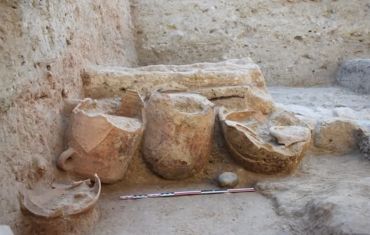
Excavation did not reach levels earlier than the Classical period in the central part of the trench. On the contrary, Archaic floor levels and walls were found to the east and north. Remains of Archaic date were nicely preserved to the north of looter’s trench 975. There, a room was exposed whose southern limit had been cut by the looter’s trench. Its eastern and northern limits were, however, well-preserved. They were embodied by walls of stone supporting a mud brick elevation. The latter is especially well-preserved for wall 978, which still possesses a nice white plaster coating on its western face. The collapse of the mud brick superstructure of the walls preserved the furniture of the room in situ (fig. 2). The team retrieved several ceramic containers (imported Phoenician commercial amphoras and locally made Plain White amphora and jug), as well as a Bichrome barrel-jug. The layout of the containers is remarkable: three were found lying against the northern wall of the room; three were standing against the eastern wall. Among the latter, the two Phoenician amphoras were set upside down, with their bottom and upper parts missing. The room and its contents can be confidently dated to the Cypro- Archaic period (8th-7th centuries BCE). They represent the most ancient remains found to date in the sector.