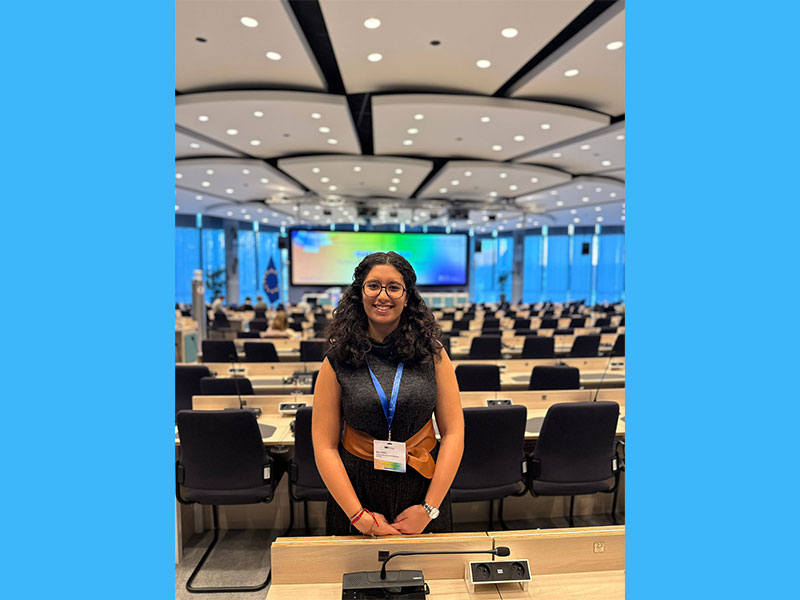
Brussels in early November buzzed with ideas, debates, and the hum of multilingual conversations. Among around 700 on-site and 2000 online participants from over 100 countries at the European Commission’s 2025 Translating Europe Forum (TEF), I spent three unforgettable days immersed in the world of translation, language, and the evolving role of AI. Being one of the 23 EMT invited students from the 81 EMT programs in 79 universities across Europe and beyond, and the only invited participant coming from “beyond”, aka the only non-EU university member ETIB-USJ, made the experience both surreal and grounding.
The forum’s theme, “Quality Matters,” was visible in every session, from panels on clear language and translation quality to debates about the human touch in an AI-driven world. I cannot recount every panel in detail, but a few stood out as particularly striking, offering insights that were both eye-opening and deeply engaging. Despite the variety of themes, a common thread running through the forum was the provocative questions that lingered in the air: with AI advancing so rapidly, what becomes of translation as a profession? Could technology ever really replace the judgment, nuance, and creativity of a human translator?
Day 1: Clarity as a Responsibility
One message rang loud and clear quality isn’t a slogan: it’s a form of duty.
The forum opened with a powerful reminder that clear language is not a stylistic preference but a democratic right. Experts showed how accessibility ensures that policies can be understood by everyone, not just specialists. When Ana Guerberof asked if AI can emulate the added value of professional translations in the relationship between quality and creativity, you could feel the pride of the pro-technology participants and the disdain in the rest of the room on the mere idea that machines could ever truly create by themselves. Later on, discussions on the definition of quality in translation emphasized that it wasn’t just a subjective standard but also guided by ISO norms, which measure accuracy, consistency, and clarity (although, the measurability of quality was debated by some).
The day continued with a spotlight on terminology, as the invisible infrastructure that makes consistency possible, and when consistency suffer, quality decreases, trust is lost, knowledge is lost… It was clear that no one was questioning the importance of terminology, not even customers. Translators and terminologists were labeled data curators who will make consumption better and whose work will be proof for the future. The forum highlighted the significance of collaborations like the WIPO Pearl initiative, where students from universities contribute to assembling specialized terminology, just like we experienced in our terminology course, here in ETIB. Thus, the tip given to translators was clearly that terminology “could be the ace up your sleeves and make you the main actors of the AI revolution”.
The first day concluded with the “Present Your Thesis” award, recognizing four students for their brilliant three-minute thesis pitches.
Day 2: Technology Meets Uncertainty
With AI defined as a gigantic calculator that only knows how to calculate, every session reinforced the same truth: translation is both science and art, and human judgment is indispensable.
The second day shifted toward visions of the future of the profession. A session on standards asked whether they could survive when AI changes processes faster than definitions. Then came one of the most memorable moments: “Should I Stay or Should I Go?” a TEF-TALK by an award-winning dubbing scriptwriter, Dr Änne Troester, who explained how AI-generated voices briefly made it onto German TV before being pulled because the quality was so poor. It wasn’t a warning, it was a reality check. She stressed that AI can never fully replace human nuance, cultural understanding, and emotion in creative work. The humorous answer to her title question was that she will stay “as long as I can pay my rent”. In summary, this quote of hers showcases her main message: “The question isn’t will it replace us? The question is do we really want to sacrifice this human heart? Translation is empathy and if we want quality we should be looking for empathy which isn’t something perfect or to be calculated, it’s about going to the gray areas.”
Midday, we, the invited students, stepped away briefly to meet the Director-General of the DGT and were honored to receive certificates of attendance.
A later panel on AI bias on “Code & Prejudice” by Marina Pantcheva added a surprising twist, with a focus on the mathematics of language showing how words and their meanings can be represented as vectors, illustrating the fascinating intersection of linguistics, logic, and computation. The session also highlighted how algorithms, especially ones fed on incomplete or skewed datasets, can reinforce gender and cultural stereotypes, reminding us that technology reflects human decisions, not neutrality. Even if we try to fix these AI flaws, bias overcorrection where diverse visual output is obligatory makes it fair but inaccurate, and the sycophant nature of AI cannot be changed as humans favor information that confirm their preexisting beliefs which makes them highly susceptible to confirmation bias. To quote her: “We have reached a turning point where we have become so advanced that we have built machines that learn from us. Now, we must learn from what they learned about us.”
Day 3: Looking Ahead With Intention
It became clear that the question isn’t whether we will be caught in the grip of technology, but how our linguistic expertise is essential in shaping it responsibly.
The final day opened with an overview of Directorate-General for Translation’s evolving services, followed by a high-level discussion on evaluating AI-generated content, not only text but multimodal outputs that will define future communication. A session on translation as infrastructure brought the conversation back to people, showing how accuracy can impact access, trust, and even safety in humanitarian contexts.
The final session, the youth panel, offered critical reflections from emerging translators on AI, ethics, and the future of the profession. The debates highlighted both excitement and caution: AI can increase accessibility, but quality, ethics, and human judgment cannot be compromised. A range of mindsets emerged, from “customers want it fast and they define what they want” to “humans were here first, why include AI in everything?”. The discussion asked thought-provoking questions such as “Who does AI benefit? To whose detriment? At what cost?” along with difficult but necessary questions about where translators fit in a rapidly shifting landscape. It was striking to hear that 42% of the participants who replied to the panel’s poll still hoped to see themselves working in translation in ten years, and that the same percentage believed that AI is reducing work quality instead of improving it.
In his closing speech, the Director-General emphasized lifelong learning as essential, noting that EMT programs exist to equip students to adapt continuously rather than train for a single fixed role. He then offered a perspective that stayed with me: the profession is not disappearing but transforming from ‘translators’ into ‘language professionals’ who ensure ethics, clarity, and quality in a multilingual world by shaping tools, standards, and communication.
To conclude, TEF 2025 felt like a beautiful (much-needed) breath of fresh air. It restored my sense of purpose and reminded me why I chose this path, and I can only hope to share that renewed sense here in ETIB. If I had to pick one lesson learned, it’s that amid change and confusion, language work, especially translation, is a profoundly human craft. Across these three days, one truth remained constant: quality matters because people do. Because, as the Director-General reminded us, “the future is being shaped by us, right now.”
Nour Kiwan
M3 – Banques et Affaires