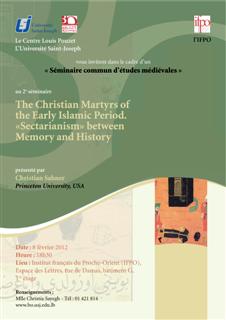
Among the untapped sources for early Islamic history are a large number of Christian martyrologies written between the seventh and tenth centuries AD – in other words, accounts of Christians saints killed under Islam. There are around forty such vitae, ranging from around thirty pages to a few paragraphs in length. They survive in a constellation of medieval languages, including Arabic, Greek, Syriac, Latin, Georgian, Armenian, and Ethiopic. Among the most interesting questions to emerge from the sources is not per se what caused the persecution of Christians in Islamic lands. Rather, it is the manner in which Christians represented this persecution to posterity, and what this may mean for understanding their views of Islam, the past, and their place in the new religious cosmos. This presentation will focus on a small group of texts in an effort to answer a few key questions: Do the martyrologies constitute a coherent body of historical evidence? What caused violence against Christians in the early Islamic period? And what do the texts reveal about the creation of sectarian identity in early Islamic societies?
The Christian Martyrs of the Early Islamic Period :
Christian C. Sahner
Collaborateur(s)
- Institut Français du Proche-Orient