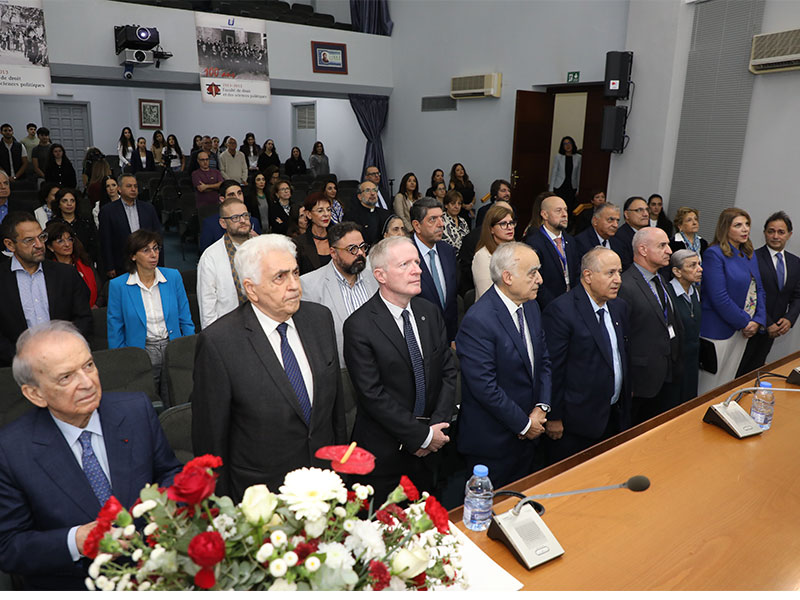
On Thursday, November 20, 2025, Saint Joseph University of Beirut (USJ) held a symposium titled “USJ’s National Role: 150 Years On” to reflect on its historic impact and future mission. It took place at the Gulbenkian Auditorium on the François Debbané Social Sciences Campus in Huvelin Street, gathering distinguished scholars, leaders, alumni, students, and friends of the University.
The event brought together Prof. Salim Daccache, SJ, Rector of USJ; Prof. François Boëdec, SJ, Rector‑Designate; Prof. Salah Abou Jaoude, SJ, First Vice‑Rector; His Excellency Mr. Ghassan Salame, Minister of Culture; and former ministers Marwan Hamade, Nassif Hitti, and Ziad Baroud.
In his opening remarks, Prof. Daccache emphasized that the symposium was not intended simply to “honor its remarkable history,” but to “confront a challenging present” and “shape a viable future.” He noted that USJ has gone beyond educating students, it has shaped national institutions, fostered civic responsibility, and embedded a culture of academic freedom, intellectual honesty, and commitment to Lebanon.
Reflecting on the University’s history, Prof. Daccache outlined three key lessons: boldness as a driver of progress, responsibility as the foundation of knowledge, and resilience as a defining trait of the USJ identity. Even amid war and crisis, he said, USJ continued to teach, unite communities, and provide care. In a country “saturated with empty rhetoric and fleeting indignation,” he argued, USJ must help restore the nobility of debate and reaffirm the power of reasoned discourse. For him, the University must remain a beacon where new paths of national renewal are shaped, guided by creativity, responsibility, and active civic engagement.
Prof. Abou Jaoude expanded on the symposium’s theme by underscoring the essential role of the University in the political and social fabric of a nation. He described USJ as a space where collective consciousness is formed, critical thinking is cultivated, and civic coexistence is built. He stressed that the University must continually reassess its evolution and the relevance of its mission in a changing society.
To illustrate USJ’s civic purpose, Prof. Abou Jaoude recalled the University’s pivotal transformation in 1975. In the midst of Lebanon’s civil war, USJ restructured itself into an autonomous, resilient institution rooted in the national reality. He characterized that shift as “a bold choice,” a deliberate turn toward serving the nation rather than merely reproducing traditional academic models. Today, he said, this commitment lives on through democratic governance, representative structures, and a vigorous focus on active citizenship that serves as a model for the Lebanese higher education landscape.
In the symposium’s keynote address, H.E. Mr. Ghassan Salame offered a personal and historical perspective. Speaking from the Gulbenkian Auditorium, where his academic journey began, he traced USJ’s pivotal role in shaping Lebanon, highlighting its Faculty of Law and Political Science as the cradle of the nation’s political and administrative elite, before analyzing the 1969 turning points and the rise of a “fighting elite” shaped by the era’s political upheavals.
Salame recounted his return to Lebanon in 1978, reflecting on the profound ideological shifts, rising tensions, and competition among centers of knowledge that eroded USJ’s cultural primacy. He invoked the work of Gramsci, arguing that the era of USJ’s unquestioned cultural dominance had passed, ushering in a long period of adaptation. He credited the “Ducruet transition era” with sustaining the institution through these challenges, without which USJ might not have survived.
Turning to contemporary issues, the Minister highlighted pressures facing modern universities: the rise of professionalized education, the imperative to strengthen research, the adaptation of curricula to evolving social needs, and the linguistic challenge of balancing English and other languages of instruction. He cautioned that exporting a university brand is far easier than exporting the quality of education without a strong local foundation.
Salame stressed that Lebanon’s stability is fundamental for USJ to fully fulfill its mission. “One of the greatest challenges is making the country a safe foundation capable of hosting students from the region,” he said, noting this responsibility lies with the state.
He also framed USJ’s mission in a global context, referencing the rise of digital knowledge platforms, the impact of artificial intelligence on academic integrity, the spread of misinformation, and the widening gap between degrees and social success. He challenged the University to choose engagement over narcissistic withdrawal — a choice he argued is demanded by USJ’s 150‑year legacy. He urged the institution to support Lebanon by contributing innovative economic models, bridging technological gaps, proposing political alternatives, and redefining the country’s sovereign role amid regional shifts.
The day continued with two panel discussions featuring members of USJ’s academic community. The sessions examined the University’s pedagogical, intellectual, and political contributions, as well as its vision for the future. The symposium closed with remarks by Prof. Salah Abou Jaoude and Dr. Lina Iskandar Hawat, Senior Lecturer at the Faculty of Religious Studies, who highlighted the key insights and offered final reflections.
Click here for photos
Read also: Colloque sur le rôle national de l'USJ : 150 ans après