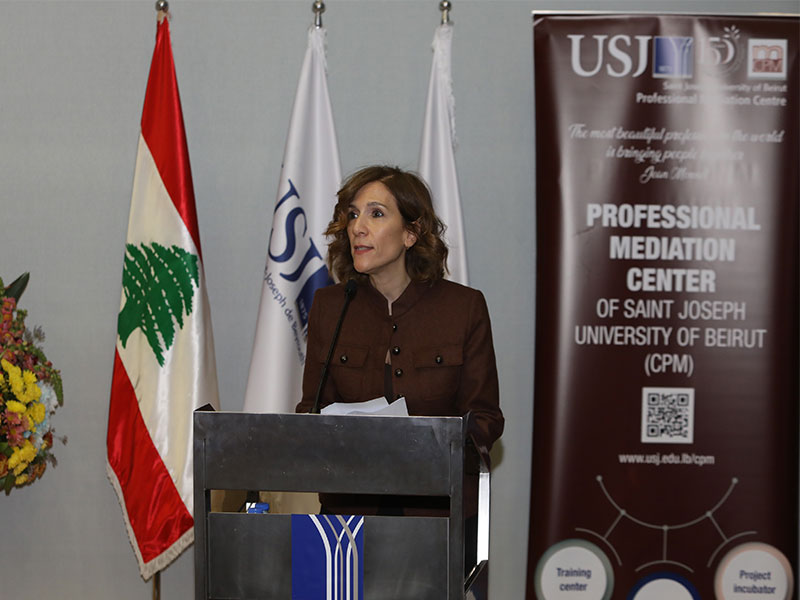
At the initiative of the Professional Mediation Center (CPM) at Saint Joseph University of Beirut (USJ), the event “Women Local Mediators at the Forefront of Peacebuilding in Lebanon” was held on Tuesday, January 27, 2026, at the François S. Bassil Auditorium, USJ Innovation and Sports Campus. Organized in collaboration with UN Women and International Alert, with support from the Government of Finland, the event highlighted the essential role of women local mediators in conflict prevention, social cohesion, and peacebuilding across Lebanon.
The event brought together Prof. François Boëdec, SJ, Rector of Saint Joseph University of Beirut; the Ambassadors of Finland, Norway, Poland, and Colombia; representatives of the Embassies of Canada, Mexico, Belgium, and Brazil; as well as institutional partners, civil society actors, and women local mediators from across the country.
In her opening remarks, Mrs. Johanna Hawari Bourjeily, Founder and Director of CPM, spoke of the symbolic and human significance of the initiative. She reflected on the power of women’s solidarity across borders and cultures, emphasizing that courage begins with “the choice to change,” the very choice that led to the creation of CPM in the aftermath of the July 2006 war.
She emphasized that women are not only affected by conflict; they are equipped to resolve it. Through distinct skills and lived experience, they contribute directly to mediation efforts and to embedding a culture of nonviolence within their communities.
As Lebanon’s first mediation center, CPM was founded with a clear mission: building trust and restoring dialogue between individuals and communities. Today, it operates as a training center, mediation hub, and project incubator in Beirut, Tripoli, Sidon, and Dubai. Over the past twenty years, the Center has trained more than 15,000 school students in nonviolent communication and mediation, more than 5,000 university students across the region, and over 1,000 professional mediators, 80% of whom are women.
Mrs. Hawari Bourjeily also highlighted the partnership launched with UN Women in 2018, beginning with a pilot initiative implemented with UNIFIL and expanding in 2020 into a nationwide programme in collaboration with International Alert. This effort has reached more than 240 women across ten Lebanese regions: Akkar, Tripoli, Kesrouan-Jbeil, Beirut, Al-Shouf, Mount Lebanon, Zahle, Ein El Hilweh, Tyre-Abbassieh, and Marjeyoun. Today, the initiative counts 34 professional mediators and 140 women local mediators actively serving their communities.
In his remarks, Prof. Boëdec welcomed the project’s growth and continuity, placing it at the heart of the University’s mission in service of Lebanon and the region. Since 2018, he noted, CPM has served as an implementing partner of UN Women under the regional programme Women, Peace and Security in the Arab States, which aims to strengthen women’s capacities at the community level to prevent, mitigate, and resolve conflicts while promoting their meaningful participation in peace efforts.
He described the work carried out between 2018 and 2025 as substantial, noting how the project evolved from a pilot initiative in southern Lebanon into a national programme spanning ten regions. He underscored the strength of the approach that integrates community mediation, nonviolent communication, and gender-sensitive conflict analysis, while adapting to Lebanon’s evolving political, socio-economic, and security context.
Reflecting on the successive crises Lebanon has endured, Prof. Boëdec said that the project’s continuity at times felt almost miraculous, made possible by the commitment and professionalism of its teams. He paid tribute to the 140 women local mediators whose leadership, particularly during the programme’s third phase, proved essential in humanitarian response efforts, local governance structures, shelters, and risk management mechanisms.
Mrs. Gielan El Messri, UN Women Representative in Lebanon, stressed that community peacebuilding must move beyond theory and take root in everyday realities. In Lebanon, she noted, tensions often stem from everyday challenges — resource management, pressure on public services, misinformation, and the consequences of displacement — making early intervention and inclusive dialogue indispensable.
She underscored the decisive role of women local mediators as frontline actors capable of offering solutions grounded in deep contextual knowledge. Their work has evolved into structured collaboration with municipalities, public institutions, security actors, and humanitarian partners, helping safeguard social cohesion during periods of acute vulnerability.
She also placed this progress within a broader milestone moment: the 25th anniversary of UN Security Council Resolution 1325 and the forthcoming development of Lebanon’s second National Action Plan for its implementation. Women’s participation in decision-making, she affirmed, remains fundamental to sustainable peace.
H.E. Anne Meskanen, Ambassador of Finland to Lebanon, reaffirmed that advancing the Women, Peace and Security agenda remains a consistent priority of Finland’s foreign policy. “Sustainable peace is impossible without women’s full, equal and meaningful participation,” she stated, expressing pride in Finland’s support to UN Women, the Women’s Peacebuilding Network, and women peacebuilders in Lebanon.
She emphasized the importance of investing in women’s political and economic empowerment, in all their diversity, including Palestinian women, non-Lebanese women, and women with disabilities. She also stressed the need to connect local action to clear national messaging in order to strengthen women’s visibility and access to decision-making spaces.
In her closing remarks, Layal Al Assaad, Country Director of International Alert in Lebanon, reflected on the richness of the discussions. She affirmed that local mediation is neither an institutional luxury nor a theoretical concept, but a daily commitment carried forward by women deeply rooted in their communities. She highlighted the strength of the networks built through the programme and the urgency of maintaining safe spaces that foster solidarity and collective action.
She concluded by noting that the event is part of a sustained effort to anchor women’s leadership in conflict prevention and peacebuilding, in alignment with the Women, Peace and Security agenda and the implementation of Resolution 1325.
The event featured the screening of two videos. The first showcased mediation initiatives led by women across the ten regions. The second, “Voices of Women from the South,” captured the lived experiences and resilience of women in southern Lebanon. A panel discussion followed, bringing together women local mediators and institutional representatives to examine challenges, share best practices, and explore the future of community mediation in Lebanon.
The exchanges highlighted the strong alignment between grassroots mediation efforts and national and municipal institutional frameworks, reinforcing a shared commitment to sustainable peace.
Click here for photos
Message from Professor François Boëdec, S.J., Rector of USJ
Read also: Le CPM et les femmes médiatrices communautaires au cœur de la construction de la paix