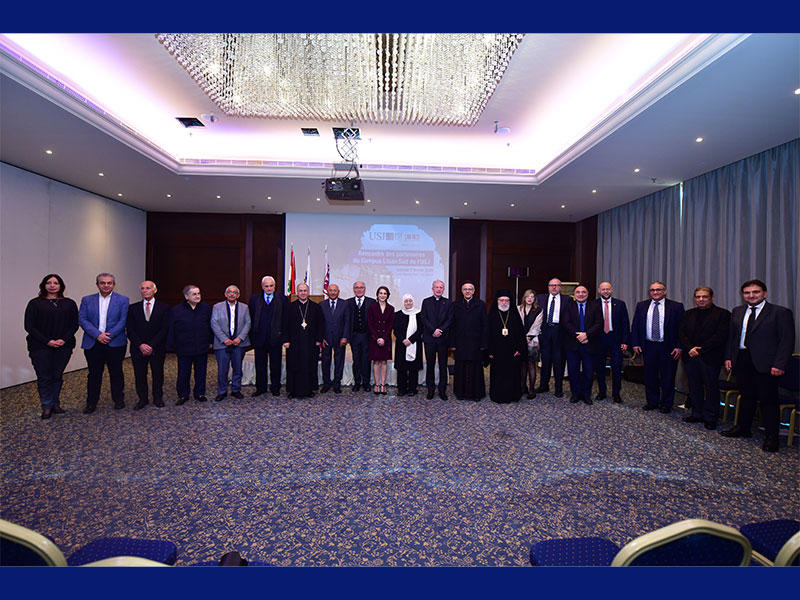
The South Lebanon Campus - Rev. Fr. André Masse, SJ (CLS) of Saint Joseph University of Beirut (USJ) hosted its annual partners’ gathering, bringing together political, academic, educational, economic, and civil society leaders. Attendees included former MP Bahia Hariri; MPs Oussama Saad, Michel Moussa, and Ali Osseyran; former Minister Abbas El Halabi, President of the Federation of USJ Alumni Associations; Bishops Elias Haddad, Maroun Ammar, and Elias Kfoury; a representative of Sheikh Mohammad Osseiran; Mohammad Saleh, President of the Chamber of Commerce, Industry and Agriculture of Sidon and South Lebanon; and the presidents of the Municipal Unions of Sidon and Zahrani, Jezzine, and Nabatieh. Also present were Ali Sherif, President of the Sidon Merchants Association, Prof. François Boëdec, SJ, Rector of USJ, Prof. Dina Sidani, Director of CLS, school directors from partner institutions, and the winners of the Nourish competition.
In her opening remarks, Prof. Sidani welcomed the Campus’s partners and friends, noting that the annual meeting is “more than a formal event; it is an opportunity for meaningful exchange and shared camaraderie.” She underlined the Campus’s mission to foster “a region that values youth and builds futures,” where young people can envision and shape their paths.
Resilience and Academic Excellence Addressing Emerging Needs
Acknowledging Lebanon’s recent challenges, Prof. Sidani praised the resilience and dynamism of the university community, describing the past years as “demanding, ambitious, and productive.” She presented key achievements, including new English-language programs tailored to regional needs: a Bachelor in Data Science and a Bachelor in Education, concentration: Orthopedagogy, designed to promote inclusive schools and societies.
Campus modernization was also highlighted, with new physics and chemistry laboratories and a second computer lab equipped with advanced engineering and data science software.
A Collective Vision Built on Regional Alliances
Prof. Sidani emphasized that the Campus’s growth is the result of a “network of alliances” and a shared vision with educational, economic, and civil society partners. She affirmed that the future of communities is built “with, for, and by our youth,” citing a regional solidarity strategy launched two years ago. This approach focuses on three pillars: strengthening collaboration with local schools, providing targeted benefits for students, instructors, and staff, and recognizing excellence through the Rector’s Regional Merit Scholarship, awarded to students scoring at least 17/20 in secondary school and the official baccalaureate.
She also highlighted partnerships with businesses, institutions, and NGOs that support collaborative projects and student engagement, including cooperation with the Chamber of Commerce, Industry and Agriculture of Sidon and South Lebanon, Jubaili Company, the Ahlouna Association, and the Beirut Rotary Club. The USJ Alumni, represented by El Halabi, was praised for its ongoing contribution to fostering solidarity and acting as ambassadors for the University.
Innovation, Responsibility, and Regional Anchoring
Looking ahead to 2026–2027, Prof. Sidani outlined two central priorities: innovation and shared responsibility. She stressed CLS’s role as a catalyst for a “responsible and supportive” region, offering youth opportunities to succeed without the need to emigrate. She called for collaborative action in response to rapid technological, ecological, and economic changes, reaffirming the Campus’s commitment to student entrepreneurship, civic initiatives, and partnerships across public, private, and civil society sectors.
Reflecting on Sidon’s designation as Lebanon’s 2027 cultural capital, Prof. Sidani described the recognition as validation of the Campus’s regional engagement. She noted that the title celebrates “heritage, knowledge, innovation, and openness” and represents a shared project showcasing the region’s talent, institutions, and youth, sources of “pride, responsibility, and promise.”
A Historic Campus with Strong Regional Roots
Prof. François Boëdec, SJ, opened his remarks by thanking the partners for their warm welcome as he steps into his new role. Although USJ was hosting the gathering, he observed, “it is you who are welcoming me here today.” He reflected on his long-standing connection to the Sidon Campus, describing it as “beloved and deeply woven into the University’s history.”
Marking the upcoming 50th anniversary of USJ’s presence in Sidon in 2027, he highlighted the city’s selection as Capital of Culture and Mediterranean Dialogue, celebrating its historical and cultural richness. He reaffirmed USJ’s enduring commitment to South Lebanon, emphasizing the importance of supporting youth in building dignified lives, while recognizing the courage and resilience of local families and institutions.
Partners at the Core of the University’s Mission
Prof. Boëdec reaffirmed that USJ’s mission in the region depends on the enduring trust of its partners. Their presence, he noted, is “a powerful source of support” for the University, and he described them as “true co-actors” in advancing its mission and aligning education with local needs.
He emphasized the vital contributions of regional institutions, businesses, alumni, and especially schools. Addressing the principals and school directors present, he underscored the long-standing bonds of trust and collaboration, reflected in initiatives such as student competitions.
Academic Evolution: Trilingualism and Market-Relevant Programs
Prof. Boëdec outlined the Campus’s recent growth, citing expanded academic offerings and increased enrollment. He noted new programs in Data Science and Orthopedagogy as evidence of USJ’s responsiveness to labor market needs.
While reaffirming its historical commitment to Francophone culture, the University is increasingly adopting a trilingual model: French, English, and Arabic, enhancing students’ future opportunities and employability.
Solidarity in Action for Students
The Rector reiterated USJ’s nonprofit mission, emphasizing that financial constraints should not limit access to quality education. Through a robust scholarship system, including regional solidarity and merit scholarships, USJ supports families and enables students to pursue strong academic paths. “Solidarity is not a slogan,” he stated, framing it as a tangible institutional commitment in service of the broader community.
Concluding, Prof. Boëdec praised the CLS team and instructors, offering special recognition to Prof. Dina Sidani for her “continuous and effective leadership.” Proud to serve a university he described as deeply committed to its students and the diversity of their backgrounds, he highlighted the strength of the trust-based bonds linking the university community and its partners, noting that they inspire confidence in the future despite challenges. He concluded by thanking all partners for their continued trust.
The event also celebrated the winners of the Nourish competition, which involved 79 students from 15 schools submitting 82 videos. Entries were assessed on identity expression, storytelling, creativity, and engagement. First place went to Clara Farhat of École Saint-Joseph de l’Apparition, second to Rayan Yassine of Kossaytbe High School, and third to Karim Attieh of Kayan International Highschool.
Read also: Rencontre des partenaires de l’USJ-Campus du Liban Sud
Click here for photos