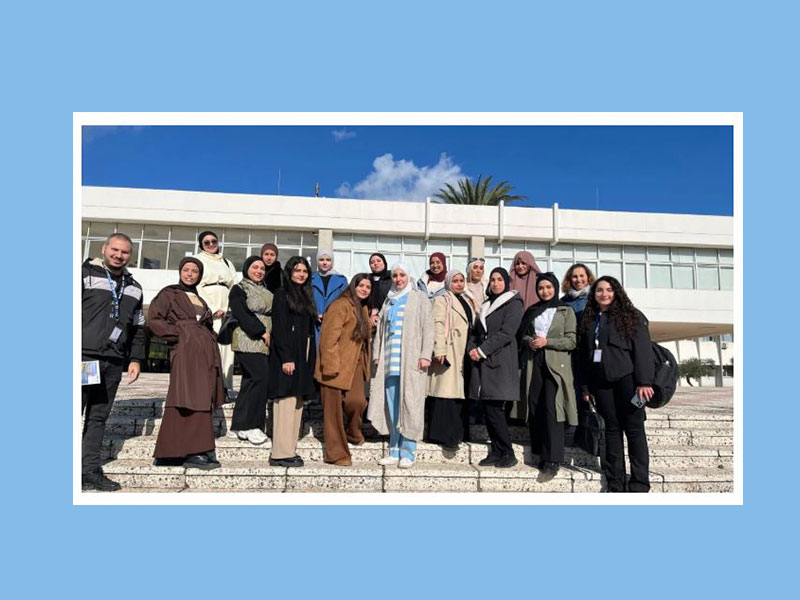
USJ’s Professional Training Center adopts a holistic approach to support learners’ access to employment.
By Elissa Makhoul
As Lebanon continues to grapple with overlapping crises, the Professional Training Center (CFP) at Saint Joseph University of Beirut (USJ) is expanding its programs to include young people without a baccalaureate who are seeking practical professional skills and access to employment.
Originally established to provide lifelong learning opportunities for graduates and professionals looking to update their skills, CFP has broadened its mission through partnerships with civil society organizations and socially oriented initiatives.
Developed in collaboration with the American Near East Refugee Aid (Anera), one of the Center’s technical and vocational training programs targets young people from vulnerable communities, including those who have not completed secondary education. The initiative gives participants access to university-level training designed to help them build practical expertise and improve their employability.
“The program focuses on technical skills that are in demand in the labor market. It is not intended to replace traditional university degrees,” says Fadi El Hage, Delegate of the Rector for Professional Training and Director of CFP.
Particularly relevant in Lebanon’s current context, the program offers career-oriented training in fields ranging from management and hospitality to AI-assisted fashion design, agriculture, dairy production, and nursing. “Some participants were deeply moved when they first entered the university. They told me they had never imagined they would one day attend university courses,” El Hage recalls.
Upon completion, participants receive certificates validating the skills they have acquired. According to El Hage, these qualifications can help them enter the workforce “especially during times of crisis and war, instead of facing unemployment.”
Funded by Anera, the program is delivered across the Beqaa, northern Lebanon, and southern Lebanon. It includes approximately 100 hours of training combining theoretical instruction with practical application. “We hope the internships they complete will create pathways to employment,” he adds.
Under its social outreach initiatives, CFP also partners with the Armenian Fund of France following the signing of a memorandum of understanding aimed at supporting the Armenian community in Lebanon. The program provides women and young people with job-oriented skills through training in areas such as dental assistance, healthcare assistance, and digital marketing.
“We are working to expand these programs so that access to training is not limited by financial means or educational background,” El Hage says. “Our goal is to provide meaningful training opportunities for underserved communities.”
AI Reshapes Professional Training
For El Hage, international accreditation has become a key component of the CFP’s lifelong learning strategy and an important added value for learners.
Recent programs include executive coaching accredited by the International Coaching Federation and a leadership program accredited by Maxwell Leadership. “We ensure that our programs meet international standards. Accreditation is now essential within the framework of flexible learning pathways and the University’s evolving vision,” he explains.
Beyond technical expertise, CFP also equips learners with transferable psychosocial skills that support career development and professional transition. These include communication, negotiation, team building, public speaking, stress management, and emotional intelligence, alongside specialized technical training in healthcare, engineering, and other sectors.
“Today, with the rise of artificial intelligence, we have also developed new certificate programs,” says El Hage.
CFP has integrated AI into many of its training tracks and now offers a broad range of programs in both generative and specialized artificial intelligence. Demand for discipline-specific AI training continues to grow across fields such as medicine, dentistry, law, publishing, fashion design, and education.
“We are increasingly receiving requests for AI training tailored to specific professions,” El Hage explains, noting that the Center also provides customized training programs and needs assessments for companies and institutions.
Bridging Academic Research and the Labor Market
CFP supports professional integration through several channels. In addition to internships, which often serve as entry points into employment, the Center collaborates with USJ’s Career and Placement Office, Student Life Office, and Berytech, the University’s technology and innovation hub.
“It is a complete ecosystem and a holistic approach based on collaboration between different USJ entities to help students and CFP graduates access the job market,” says El Hage.
Another defining feature of the CFP’s lifelong learning programs is its emphasis on teaching quality. Trainers themselves are required to complete dedicated train-the-trainer programs. “Being an instructor does not automatically make someone an effective trainer. Training requires a different approach,” El Hage notes. Programs are also tailored to local market needs and designed within the Lebanese context. “We want learners to build their careers in Lebanon. We are not training them to leave the country,” he says.
At the same time, CFP seeks to translate USJ research into practical applications by working closely with businesses to improve productivity, techniques, and production quality. “Today, we are doing everything possible to ensure that research contributes directly to the professional world,” El Hage concludes. “The divide between academia and the labor market no longer exists in the same way. Stronger connections are being built between researchers, technicians, and industry professionals.”
Also read:Des formations professionnalisantes ouvertes aux jeunes sans baccalauréat